
Transactional Data Reporting (TDR): What GSA Contractors Need to Know

If you’re a GSA Schedule contractor, chances are you’ve heard the term Transactional Data Reporting (TDR) floating around lately. But what exactly is it? How does it affect your contract? And what’s the difference between TDR and non-TDR requirements? Let’s break it down in plain English.
What is Transactional Data Reporting?
Transactional Data Reporting, or TDR, is how GSA collects detailed data about the actual products and services sold through the Multiple Award Schedule (MAS). Instead of relying on old-school pricing disclosures and tracking “most favored customer” discounts, GSA now wants order-level data directly from contractors.
Every month, participating contractors submit 16 key data elements (things like SIN, part number, unit price, total price, order date, and shipping ZIP code) through the Sales Reporting Portal. This gives GSA a clear picture of what the government is really paying—and helps them make better buying decisions.
Why Does TDR Matter for Contractors?
TDR is designed to be less burdensome than the traditional requirements under the Commercial Sales Practices (CSP) and Price Reductions Clause (PRC). Here’s what that means for you:
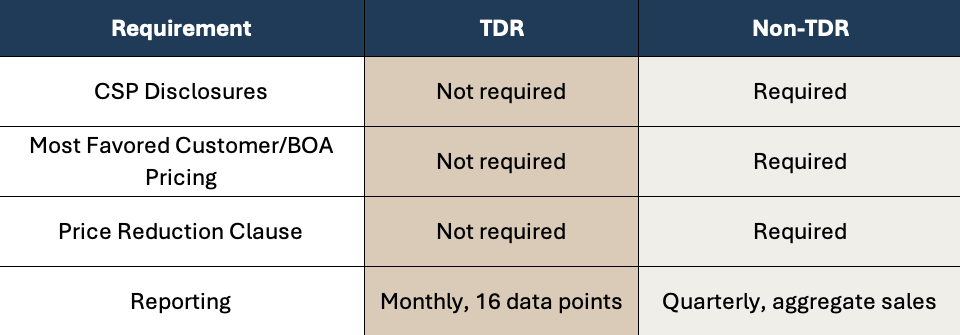
No CSP disclosures. You don’t have to hand over your commercial pricing practices during offer or modifications.
No PRC tracking. You’re not on the hook for monitoring and reporting price reduction violations.
Still reporting sales. You’ll just do it monthly at the transaction level instead of quarterly at the SIN level.
In other words: more reporting detail, but less compliance risk.
TDR vs. Non-TDR: Key Differences
Here’s a quick snapshot of how TDR requirements compare to non-TDR requirements:
The TDR Transition: What’s Changing?
Originally, TDR was rolled out as a pilot program in 2016 for select Special Item Numbers (SINs). But in June 2025, GSA announced that it’s expanding the program significantly.
Currently, there are 177 SINs considered TDR eligible If your Schedule includes one of the 62 newly eligible SINs, TDR will become mandatory.
Once you submit & accept the modification, your PRC liability ends and your TDR obligations kick in at the start of the next reporting quarter.
Eventually, all SINs will transition into TDR in future Solicitation Refreshes.
👉 Want to see if your SIN is TDR-eligible? Check this GSA table, type your SIN in the filter box, and find out.
How Will This Affect You?
If you’re currently non-TDR, moving into TDR could actually lighten your administrative burden by eliminating CSP and PRC requirements. But you’ll need to be prepared for detailed monthly reporting.
If you get an email from GSA about a mandatory TDR opt-in modification, don’t ignore it! That means your SIN is now covered under TDR and you’ll have to accept the mod to stay compliant.
Need Help Navigating Transactional Data Reporting (TDR)?
At Heron Writing & Consulting, we help contractors just like you understand and manage changes to their GSA Schedule contracts. If you’ve received a mandatory TDR modification email—or if you just want guidance on what TDR means for your business—we can walk you through the process.
✅ Bottom line: TDR is here to stay, and more SINs will be transitioned in the coming months. Whether it feels like a relief or an extra reporting headache depends on how ready you are.


Comments